When gilding calligraphy, the easiest solutions to use are those that flow freely on a pen nib or brush tip. Here are my simple instructions for using Gum Ammoniac to create a gilding mordant for this use. This is a “flat” gilding, so don’t expect this to be very raised up off the paper though multiple coats can be applied.
Gum ammoniac is a plant sap/resin that was historically used in illumination. It could be obtained in the Middle East and parts of Africa. Today, I have mainly found this for purchase as an incense resin but it still works just as well. A quite small amount of material produces quite a bit of liquid.
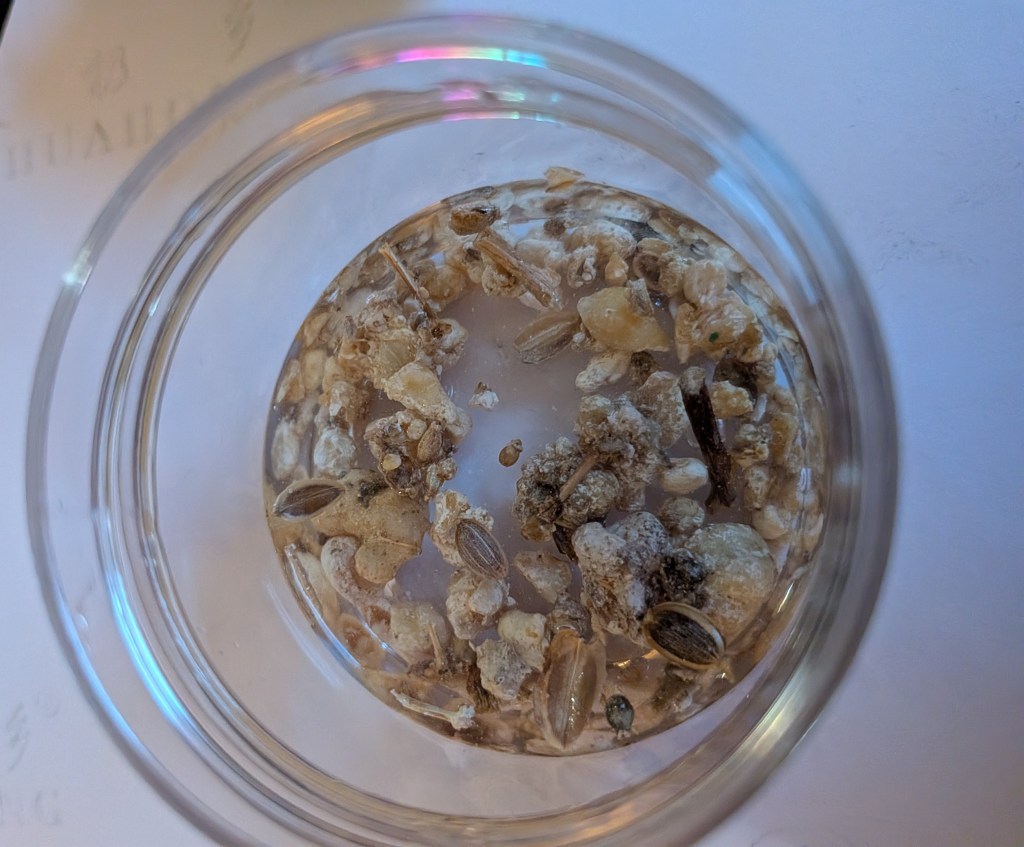
To prepare the mordant, you will simply pour out an amount of the gum and related “plant stuff,” twigs and all into a jar. At this point, you don’t need to worry about there being extra material – you’re going to strain it out later.

Then, tap the jar a bit to even out your material inside. You’ll put just enough water to cover the gum and no more. Like this:

You could use distilled water for purity, I suppose, but I didn’t bother. You’re then going to let this sit for 24 hours or so. Doesn’t need to be refrigerated at this point. Over time, it’s going to develop a milky-looking texture – this is a good thing. Here’s a couple images to show what I mean by this.


When it looks like melted chalk (see my photo above), it’s ready to be strained. You can do this with a very fine sieve, but you will probably need to sieve it a couple of times. I personally like to use the kind of nut milk bags you use for almond milk as I can hang it over the jar if I want and walk away. (I wash and reuse these as well. Only for gilding projects.)


Stir the strained product a bit to make sure there are no lumps or extra bits. Strain again if you need to. It should be thin as ink. Any time you are working with gilding mordants, know that any lumps or bubbles you leave in the mordant will appear as lumps or bubbles in the metal you’re using.
Also, I highly recommend washing everything as soon as you are finished with it. This is a gum and it will be much harder to clean once it’s dried.
Then, let this mixture rest for at least 24 hours. I would recommend refrigerating it to last longer. You do need to stir it a bit after refrigerating or resting it.
When you’re ready to gild, use a brush or pen to “paint” the area that you want to gild. Let it sit until it dries. You may want to tint it a bit with a bit of pigment or bole if you have that to give it some color – as you’ll note in my example below of the drying material, I didn’t.

If you look very carefully at my image above, you can see that at the bottom of the triangle, there is a dry, textured spot where the mordant was not applied. When I gild, that isn’t going to get gilded. This is a test swatch to see how it adhered to the material and how long it took, so I wasn’t being particularly careful. I recommend doing this before starting a major project especially if you’re in an area where humidity, etc. fluctuates.
This was done using pergamenata so I left it to dry for about 40 minutes. I probably didn’t need to wait that long, but I often gild on faux parchment which soaks up liquid and probably would need that long. (And possibly even more liquid.)
Once you’re ready to gild, you’ll need to breathe on the mordant to warm it up, then place your leaf on top of it. I recommend a paper or bamboo straw as that soaks up your saliva. I also recommend trying to breathe from the back of your throat as again, that minimizes the amount of saliva being sent into the straw.
Here’s how my final test gild went, using silver leaf. You can see the places where the mordant was not adhered. If I was doing this as a final product, I would likely add 2-3 more layers of silver to even this out and also to correct for any “spots” I might have missed.

Supplies Used in this Post:
Gum Ammonic. I purchased 1/2 ounce from this website. A little less than a third of that purchase made quite a bit of liquid so for me, a little goes a long way. Apothecary’s Garden – may be called “Ammoniacum tears” on the website. https://apothecarysgarden.com/products/ammoniacum-dorema-ammoniacum-for-incense-medicine-and-perfume-afghanistan?_pos=1&_psq=ammo&_ss=e&_v=1.0
Nut milk/straining bags – You could get these anywhere. I’m posting the ones I purchased just so you can look at them more closely. They are much finer than using a cheesecloth or metal strainer: https://www.amazon.com/dp/B0DM7ZYQ13

 Sibilia dell'Acqua
Leave a comment